
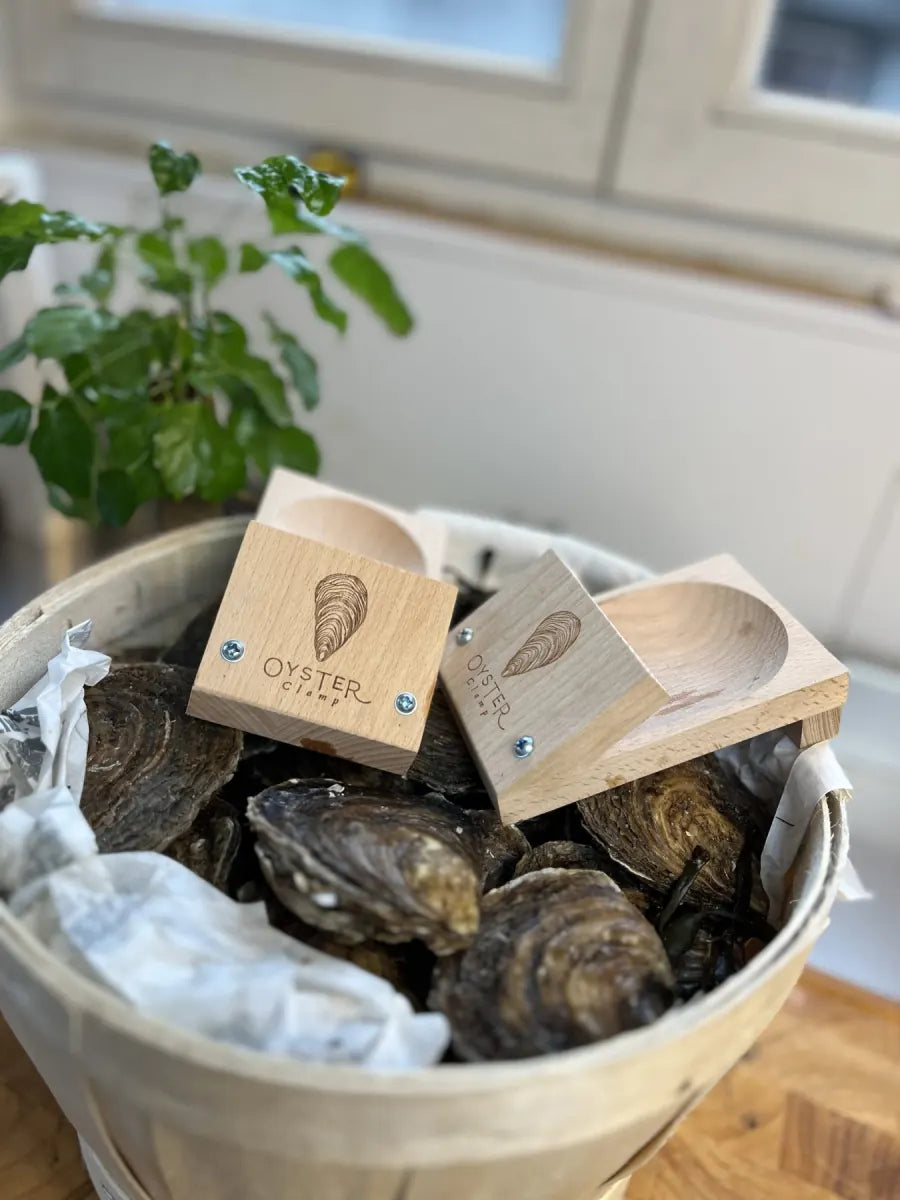





We hear this constantly from Belgian home cooks: the traditional Frenchman knife feels right, it looks right, it sits in the drawer next to the oyster cloth just like it did in their parents' kitchen. But when the box of Ostend oysters arrives on Christmas Eve and there are twenty guests waiting, that knife starts to feel less like heritage and more like a liability. At OysterClamp, we've watched this tension play out across hundreds of Belgian households, and our position is clear: you don't have to sacrifice tradition to shuck safely and quickly. The right modern tool doesn't replace Belgian oyster culture. It protects it.
What makes traditional Belgian oyster knives distinct?
Traditional Belgian and European oyster knives are built around the flat oyster, specifically the Belon-style varieties and North Sea cupped oysters from Ostend, Zeeland, and the Normandy coast. These shells are dense, irregular, and often sealed tighter than the Pacific varieties you'd find in Asian markets.
The knife style that dominates Belgian kitchens is the Frenchman, a short-bladed, slightly curved knife designed for side entry rather than hinge popping. According to practitioner guides from established shellfish suppliers, the Frenchman excels with European flat oysters precisely because it bypasses the hinge's resistance, sliding instead along the shell's lateral seam. That technique, passed down through coastal seafood culture from Bruges to Boulogne, is genuinely well-matched to local bivalves.
The problem is execution. A rigid blade on a dense North Sea shell is unforgiving. The blade can snap under pressure. The oyster shifts. Your hand follows the knife. Practitioner guides from Dexter Russell Cutlery confirm that hand slips during prying are the most common injury point for non-professional shuckers, and they happen most often when the oyster isn't secured.
Traditional knives assume skill. For someone shucking twice a year at the holidays, that skill gap is real and the stakes are high.
How modern tools close the skill gap without erasing the ritual
Modern shucking tools don't replace the knife. The best ones work with it. The innovation isn't in the blade, it's in how the oyster is held.
The OysterClamp 2.0 is the clearest example of this principle applied at a professional level. Designed by Michelin Star Chef Henk, who spent 20 years running his Michelin-starred restaurant Sans Cravate in Bruges, it uses a wooden clamp with a 25-degree lock design to hold the oyster firmly in place before the blade ever touches the shell. The mantle liquor stays in the cup. Your hand stays away from the blade path. The adductor muscle is cut cleanly.
What Chef Henk understood, and what we built this tool around, is that most shucking injuries and failures happen not because of the knife but because of the oyster moving. Secure the bivalve first, and the rest follows naturally, even for a first-timer.
For Belgian home cooks who want to keep using their Frenchman knife, the clamp pairs with it directly. You're not abandoning the side-entry technique your grandmother used. You're just making sure the oyster doesn't slide off the board while you do it.
If you're newer to shucking entirely, our guide on how to shuck oysters safely without cutting yourself walks through the full technique, clamp and knife together, step by step.
Tradition vs modern: a practical comparison for Belgian kitchens
Here's where the two approaches actually differ for a Belgian home cook preparing oysters for the holidays.
Speed. When you're opening three dozen Ostend oysters before guests arrive, the difference in shucking time is felt in your wrist before the first course lands.
Safety. The traditional Frenchman knife requires the cook to provide all the stabilization. One wet shell, one moment of inattention, and the knife finds the palm of your hand instead of the hinge. The OysterClamp's 25-degree lock eliminates that variable entirely. The oyster doesn't move. You do.
Flavor preservation. This is where Belgian cooks rightly push back on gadgets. The merroir of a North Sea flat oyster, that mineral, iodine-sharp taste of cold Atlantic water, is partly carried in the mantle liquor. Rough shucking spills it. A clamp that holds the shell level and steady actually preserves more liquor than a rushed hand-held shuck. Modern doesn't mean careless.
Cultural fit. Chef Henk is Belgian. His restaurant is in Bruges. The OysterClamp wasn't designed in a generic product lab, it came from 20 years of professional shucking in a country where oysters are a serious part of the table. That context matters when you're deciding whether a tool belongs in your kitchen.
For a deeper look at how clamps and traditional knives compare on the beginner side, our article on the best oyster shucking tool for beginners covers the full breakdown.
Is the OysterClamp worth it if you only shuck a few times a year?
This is the objection we hear most often, and it's a fair one. If you're only opening oysters at Christmas and maybe Easter, does a purpose-built tool justify the cost?
Our answer: the cost of a bad shucking experience, whether that's a cut hand, a spilled shell, or a ruined Christmas platter, is higher than the tool. The OysterClamp 2.0 is currently €25.95, discounted 50% from €51.95, and it carries a lifetime warranty. That's a one-time purchase that covers every holiday gathering for the rest of your life.
It also comes with something a generic knife from a kitchen shop doesn't: the credibility of a Michelin Star chef who designed it specifically for the oysters you're actually buying. That's not marketing language. That's the difference between a tool built for Pacific half shells in a restaurant context and one built for the flat Belons and cupped Zeeland oysters that show up at Belgian fish markets in December.
If you want to give it as a gift to someone who loves oysters but finds shucking intimidating, our guide to choosing an oyster shucking tool as a gift covers exactly that use case.
The real choice in Belgian kitchens isn't tradition versus modern. It's unprotected technique versus technique with the right support behind it. Keep the Frenchman knife, keep the ritual, and stop worrying about the oyster slipping. Get the OysterClamp 2.0 and open your next box of Ostend oysters the way they deserve to be opened.
Frequently asked questions
What type of oyster knife is best for Belgian flat oysters?
The Frenchman-style oyster knife is the traditional choice for Belgian flat oysters like Belons and North Sea varieties. Its short, slightly curved blade is designed for side entry rather than hinge popping, which suits the dense, flat shells common to Ostend and Zeeland oysters. Paired with a stabilizing clamp, it's the most effective combination for Belgian home cooks who want both cultural authenticity and reliable safety during shucking.
Can I use the OysterClamp with my existing oyster knife?
Yes. The OysterClamp 2.0 is designed to work alongside your existing knife, including traditional Frenchman-style blades. It holds the oyster securely in place using a 25-degree lock so your knife hand can work freely without risk of the shell shifting. You keep your preferred shucking technique. The clamp simply removes the most dangerous variable, an unsecured oyster, from the equation.
Is a special shucking tool necessary if I only eat oysters at Christmas?
A purpose-built tool is especially valuable for occasional shuckers. Without regular practice, a traditional knife alone requires skill you may not have built up. The OysterClamp 2.0 is designed to require no prior experience, so it performs the same whether you shuck weekly or once a year. At €25.95 with a lifetime warranty, it's a one-time cost that covers every future holiday gathering.
Will the OysterClamp fit different oyster sizes from my local Belgian market?
The OysterClamp 2.0 is designed to accommodate the range of oyster sizes and shapes typical in Belgian and North Sea markets, including both flat and cupped varieties. Chef Henk developed the tool with regional oysters in mind after 20 years of professional shucking in Belgium. If you're unsure about fit for a specific oyster type, OysterClamp's product page includes guidance on compatible varieties.
How do I avoid spilling the mantle liquor when shucking at home?
Spilled mantle liquor is usually caused by an unstable oyster during shucking. Holding the shell level and preventing it from shifting are the two most effective ways to preserve the liquor. A clamping tool that locks the oyster at a consistent angle, like the OysterClamp 2.0, keeps the cup upright throughout the process. Technique also matters: cut the adductor muscle cleanly without levering the top shell too aggressively.
Is there a difference between shucking flat oysters and cupped oysters?
Yes. Flat oysters like Belons have a tighter, more uniform seam and respond best to side-entry technique. Cupped oysters, which include most Pacific varieties sold in Belgian supermarkets, are typically opened from the hinge. The blade shape matters: a Frenchman knife suits flat oysters, while a wider-tipped knife like the Boston or New Haven style works better on cupped shells. A stabilizing clamp improves safety and consistency with both types.
Sources
- 3 Hands Oyster Company, 2024 — Overview of oyster knife types including Frenchman and New Haven styles with technique guidance for different shell varieties.
- Shellfish Broker, 2024 — Practitioner guide covering blade materials, handle design, and safety considerations for traditional and modern oyster knives.
- Dexter Russell Cutlery, 2024 — Professional cutlery guidance on selecting oyster knives by shell type and user experience level.