





What actually makes an oyster spread work
An oyster spread is a curated half-shell presentation served to guests, typically combining freshly shucked raw oysters with condiments, ice plating, and accompanying drinks. It is not a dip. It is not a canapé. It is a live, theatrical centerpiece that signals to your guests that the host knows what they are doing.
Most home entertainers get this wrong in the same way: they treat the oyster spread as something to assemble on the fly. They start shucking when guests arrive, fall behind immediately, and the whole evening turns into a kitchen sprint instead of a party. The oysters that do make it to the plate are often mangled, drained of liquor, and presented on a pile of ice that is already melting into a puddle.
The fix is not more practice with a knife. It is a structured approach: plan the spread as a course, not a snack. Decide on your varieties in advance, prep your ice bed and condiments before guests arrive, and use a tool that lets you shuck consistently and quickly under pressure. That last part is where most home setups fall apart.
The rule of thumb here is simple: presentation is 30% oyster, 70% everything around it. The ice, the condiments, the pacing, the plating. Get those right and the spread looks intentional from the moment it hits the table.
Why your shucking tool is the foundation of the whole spread
Before variety selection, before plating, before condiments, there is one question that determines whether your oyster spread for guests actually works: can you shuck a dozen oysters quickly, cleanly, and without injuring yourself?
For most home entertainers, the honest answer is: not consistently. The towel method works when you are shucking one or two oysters slowly and carefully. It does not hold up when you are working through eighteen oysters in ten minutes with guests in the next room. The grip is inconsistent, the shell angle changes with every oyster, and fatigue builds quickly. The result is torn meat, lost liquor, and a host who has disappeared into the kitchen.
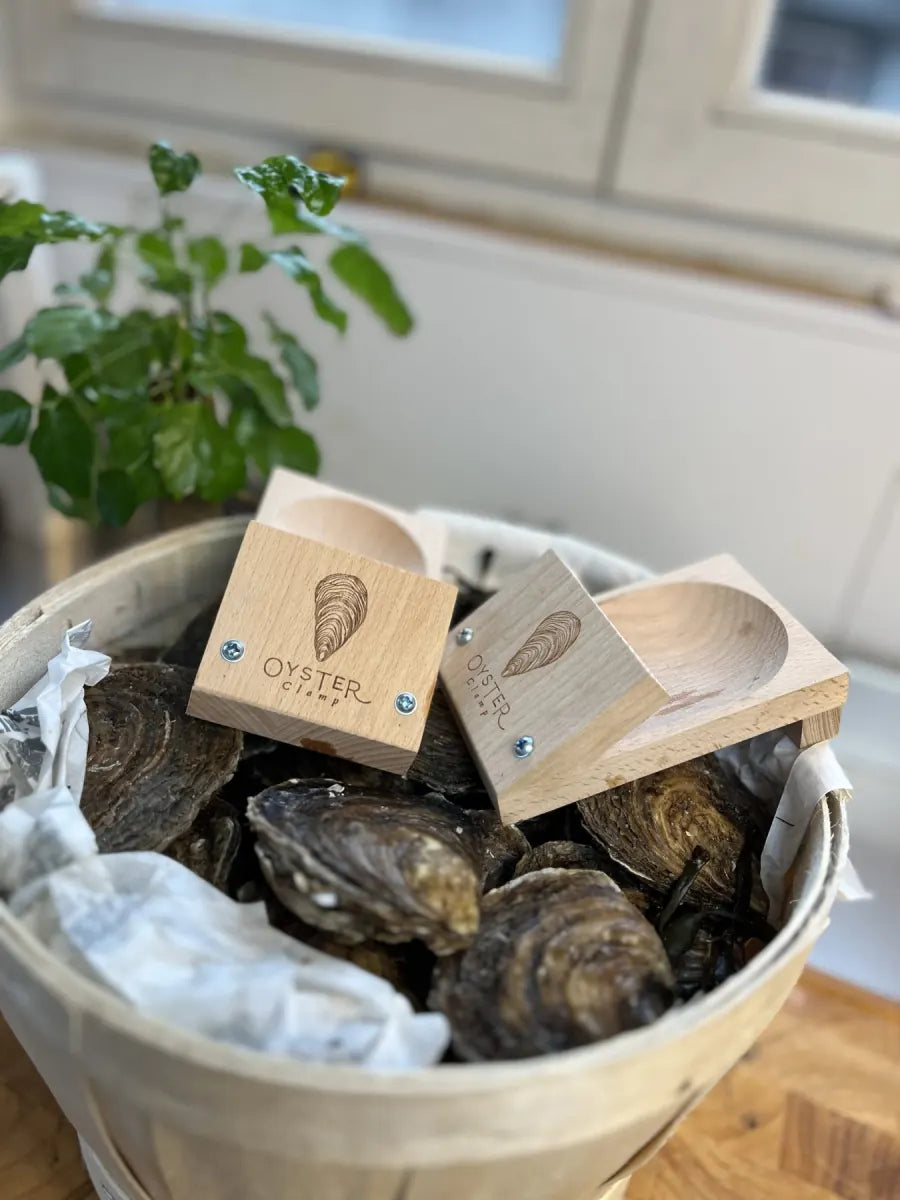
The OysterClamp 2.0 was designed specifically for this scenario. Developed by Michelin Star Chef Henk, who spent 20 years at Sans Cravate where speed and consistency at volume are non-negotiable, the tool uses a 25-degree lock design that holds the oyster at the optimal shucking angle. Your knife hand focuses entirely on the cut. The shell does not move. Your fingers stay away from the blade path. At €25.95 (currently 50% off the regular price of €51.95), it is built from AA-grade European hardwood with natural moisture resistance, requires only a warm-water rinse to clean, and comes with a lifetime warranty covering transit breakage and lost shipments.
For hosts who are serious about their oyster nights, this is the mechanical foundation everything else is built on.
Takeaway: No amount of plating skill compensates for a sloppy shuck. Solve the shucking problem first and every other element of the spread becomes easier.
How to choose oysters for a crowd
Variety selection is the first real decision after your tool, and it shapes everything downstream. Choosing oysters for a crowd is not just about flavor preference. It is about shell shape, cup depth, and how each variety behaves under the knife.
For a mixed crowd, three varieties is the sweet spot:
- One briny, flat-shelled option (East Coast styles are the classic choice) for guests who want the raw bar experience they recognize
- One meatier, deep-cupped option with more sweetness and a fuller body, ideal for guests newer to raw oysters
- One wildcard with a distinctive merroir story, something you can talk about when you set it down
Shell shape matters more than most people admit. Flat, irregular shells are harder to seat on an ice bed and harder to hold steady during shucking. Deep-cupped varieties are more forgiving on both counts. When you are shucking two or three dozen for a group, inconsistent shell geometry slows you down and increases the chance of tearing the meat or losing the liquor.
The OysterClamp 2.0 handles this directly. Its 25-degree lock design accommodates different shell sizes and shapes without requiring you to reposition your grip between oysters. That consistency is what keeps your shuck rate up when you are working through a large batch of mixed varieties.
Takeaway: Buy your oysters from a fishmonger who can tell you harvest date and origin. Freshness is non-negotiable, and knowing the merroir story of each variety gives you something to say to guests when you plate them.
What restaurant-quality plating actually looks like
Restaurant-quality oyster plating means every shell is seated securely, cup-side up, with liquor intact, arranged on a bed of crushed ice that keeps the shells level and the meat cold from service to consumption. It looks deliberate because it is deliberate.
Here is how to replicate it at home:
Build your ice bed properly
Crushed ice is standard, but it shifts. A layer of coarse sea salt or rock salt underneath the ice gives you a more stable base that holds shell position without the oysters sliding. Chill your serving platter in the freezer for thirty minutes before plating. This slows melt significantly and keeps the presentation crisp longer.
Arrange by variety, not randomly
Group oysters by variety in distinct sections of the platter. Label each section with a small card if you have guests who are new to raw oysters. This is standard practice in good raw bars and it makes the spread feel intentional rather than thrown together. It also gives you a natural opening to talk about each variety as you serve.
Liquor retention is everything
The liquor, the natural brine inside the shell, is part of the flavor profile. A clean shuck preserves it. A rushed or sloppy shuck drains it. When the liquor is gone, the oyster looks dry and tastes flat. This is the single most visible difference between a professional shuck and an amateur one.
Hinge entry technique, where the knife tip enters at the hinge rather than the lip, gives you the most control over the adductor muscle cut and minimizes shell fragment contamination. But technique alone is not enough when you are shucking at volume. Holding the shell steady with a secure, consistent grip is what makes the technique repeatable. That is the core mechanical problem the OysterClamp 2.0 solves: the 25-degree lock holds the oyster at the optimal shucking angle so your knife hand can focus entirely on the cut, not on stabilizing a slippery shell.
Condiment placement
Mignonette, hot sauce, lemon wedges, and horseradish should be arranged around the platter, not in the center. Keep them accessible but not dominating. Two or three condiment options is enough. More than that and the spread starts to look like a condiment bar.
Takeaway: Plate in rounds of six to twelve, not all at once. Oysters shucked and plated more than fifteen minutes before service lose temperature and liquor. Stagger your shucking to match your service pace.
How to shuck a large batch without falling behind
The honest answer: you need a system, not just speed. Speed without consistency produces mangled oysters, lost liquor, and shell fragments in the meat.
The system that works for batch shucking at home has three stages:
Stage 1: Prep everything before the first guest arrives
Set up your ice bed, arrange your condiments, have your serving plates ready. The only thing left to do when guests arrive is shuck. Every minute you spend arranging ice while guests are watching is a minute of social friction that pulls the host out of the room.
Stage 2: Shuck in batches of six
Six oysters per round is manageable without the ice melting or the liquor evaporating before service. It also gives you a natural pause to replenish ice, wipe the platter edge, and reset your presentation before the next round.
Stage 3: Use a tool that does not require you to improvise
The OysterClamp 2.0 was designed specifically for batch shucking under social pressure. The clamping mechanism holds the oyster securely at 25 degrees, keeps your fingers away from the blade, and eliminates the grip fatigue that slows you down after the first dozen. It is also suitable for users with arthritis or reduced grip strength, since the clamping mechanism compensates for reduced hand strength in a way that towels and improvised grips cannot.
Chef Henk developed the design after two decades at Sans Cravate, where shucking speed and consistency are operational requirements, not optional skills. The result is a tool that brings professional shucking mechanics to a home kitchen without requiring professional technique.
Takeaway: Practice your batch shucking routine before the party, not during it. Run a test session the day before with your actual tool, your actual platter, and your actual ice setup. This is how you find the friction points before guests do.
What condiments and pairings actually elevate a spread
The condiment question divides oyster enthusiasts more than almost anything else. Some argue that a great oyster needs nothing. That is a fine position if you are serving a single premium variety to a table of oyster obsessives. For a mixed crowd at a dinner party, condiments serve a practical purpose: they give hesitant guests a bridge into the experience.
The essential three
- Classic mignonette: Shallot, red wine vinegar, cracked black pepper. The ratio is roughly two tablespoons of vinegar to one finely minced shallot, seasoned generously with pepper. Make it at least an hour ahead so the shallot softens. Ideally, make it the day before. Chef Henk's oyster recipes ebook, included free with the OysterClamp 2.0, includes a champagne mignonette variation that works particularly well with sweeter, deep-cupped varieties.
- Hot sauce: Keep it simple. A clean, vinegar-forward hot sauce that does not overpower the oyster's merroir.
- Lemon: Fresh wedges only. Pre-squeezed lemon loses brightness within minutes.
On pairings, the short version: high-acid whites such as Muscadet, Chablis, and dry Champagne work across almost every oyster variety. Avoid oaky, buttery whites, which flatten the merroir and make briny oysters taste metallic.
One counterintuitive note: do not over-explain the pairings to guests. Set the wine, set the condiments, and let the spread speak. The host who narrates every bite turns a relaxed oyster night into a lecture. Trust the ingredients.
Takeaway: Mignonette made the day before tastes better than mignonette made an hour before. The vinegar has more time to mellow the shallot and integrate. It is one less thing to prep on the day.
Putting it all together: the spread your guests will remember
A great oyster spread for guests is not about perfection. It is about consistency, confidence, and the visual impact of a well-plated platter arriving at the table with liquor intact and ice still crisp.
The three things that separate a memorable spread from a forgettable one:
- Variety selection that tells a story: two or three distinct oysters with different merroir profiles give guests something to compare and discuss
- Plating that signals intention: a stable ice bed, shells seated cup-side up, condiments arranged deliberately, and no shell fragments on the meat
- Shucking that keeps pace with the room: the moment you fall behind, the energy drops. The right tool is what keeps you in front of the crowd, not chasing it
For home entertainers who host oyster nights regularly, the OysterClamp 2.0 is the tool that makes this reproducible. Not just when you get lucky with a cooperative shell, but every time, across every variety, through every batch. Browse the full range of shucking tools and accessories at the OysterClamp shop.
Ready to stop mangling oysters in front of your guests? Get the OysterClamp 2.0 for €25.95 and shuck every batch like the spread depends on it. Because it does.
Frequently asked questions
How many oysters should I serve per person at a dinner party?
Six oysters per person is the standard for a dedicated oyster course. If the spread is part of a larger menu with other appetizers, three to four per person is sufficient. For an oyster-focused evening where the spread is the main event, plan for eight to twelve per person and stagger shucking in rounds to keep everything fresh.
How far in advance can I shuck oysters for a party?
Shuck oysters no more than fifteen to twenty minutes before service. Beyond that, the liquor evaporates, the meat starts to dry out, and the temperature rises. For large batches, shuck in rounds of six to twelve rather than all at once. With the OysterClamp 2.0, the speed and consistency of the clamp makes staggered shucking practical even mid-party, so you are never more than a few minutes behind your guests.
What is the best way to keep oysters cold on a platter?
Crushed ice is standard, but it shifts and melts quickly. A layer of rock salt or coarse sea salt underneath the ice provides a more stable base and slows melt. Chill your serving platter in the freezer for thirty minutes before plating. Keep the assembled platter away from direct heat sources and serve within fifteen minutes of plating.
Does the OysterClamp 2.0 work on different oyster varieties?
Yes. The 25-degree lock design accommodates a range of shell sizes and shapes, from flat-shelled East Coast varieties to deeper-cupped Pacific and European types. Shell geometry varies significantly between varieties, and a tool that only works reliably on one type becomes a liability when you are serving a mixed spread. The OysterClamp 2.0 handles this without requiring grip adjustments between oysters, which is exactly what batch shucking for a crowd demands.
What is mignonette and how do I make it?
Mignonette is a classic French condiment for raw oysters made from finely minced shallot, red wine vinegar, and cracked black pepper. The ratio is roughly two tablespoons of vinegar to one shallot, seasoned generously with pepper. Make it at least one hour before service, ideally the day before, so the shallot softens and the acidity mellows. The free oyster recipes ebook included with the OysterClamp 2.0 includes several mignonette variations alongside full oyster spread recipes developed by Chef Henk.
How do I shuck oysters without injuring myself?
The most common shucking injuries come from the shell slipping during knife entry, sending the blade toward the holding hand. The safest approach is to secure the shell completely before applying knife pressure. Towels and gloves reduce grip control and do not hold the shell at a consistent angle. The OysterClamp 2.0 addresses this by clamping the oyster at 25 degrees and keeping fingers physically separated from the blade path, which is the same mechanical principle used in professional kitchen prep.
Sources
- Hog Island Oyster Co., 2024 — referenced for oyster preparation and condiment context in home entertaining settings
- White on Rice Couple, 2024 — referenced for oyster spread assembly and plating context
- Best Recipe Box, 2024 — referenced for condiment ratios and oyster serving guidance